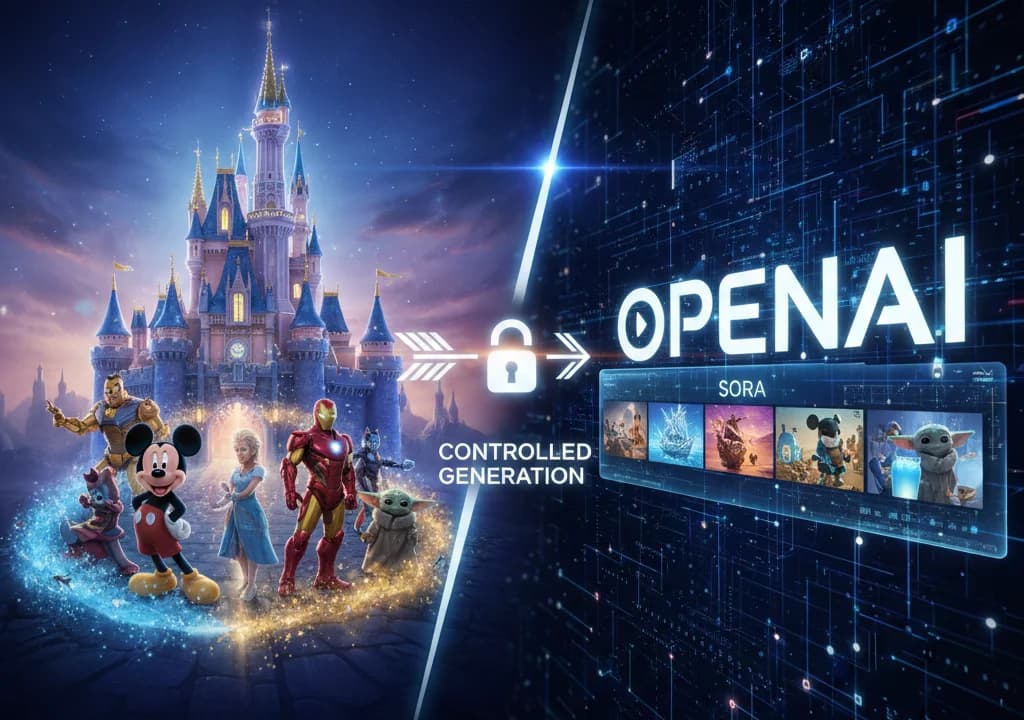
After years of fighting the rise of synthetic media in the courts, Disney is officially bringing the technology into the heart of the Magic Kingdom. A landmark $1 billion agreement with OpenAI signals a massive shift for the entertainment giant, moving it from a stance of litigation to one of deep, structural integration.
The deal, which was finalized in late 2025, positions Disney as both a licensing partner and a flagship enterprise customer. By embedding artificial intelligence directly into its operating system, the company aims to solve the persistent struggle between scaling content and protecting its most valuable characters.
A Walled Garden for Mickey and Marvel
At the center of this partnership is Sora, OpenAI’s sophisticated video generation model. Under the new terms, Sora will be able to generate short, user-prompted videos using a pre-approved library of over 200 characters from the Disney, Pixar, Marvel, and Star Wars universes.
However, this is not an open invitation for digital chaos. Disney has built a "walled garden" around its intellectual property with several strict boundaries:
No Voice or Likeness: The license specifically excludes the use of real actor voices or likenesses to protect performers.
Asset Constraints: Only specific costumes, props, and environments from the approved library can be used.
Safety Guardrails: Automated age-appropriate controls and brand safety filters are baked into the generation process.
In essence, Disney is treating AI as a "constrained production layer." This allows for a high volume of fan-driven content while ensuring that the output never drifts "off-brand."
Moving Beyond the Hype: The Power of APIs
While the ability for fans to create social clips is the most visible part of the deal, the real work is happening behind the scenes. Disney is moving away from a patchwork of ad hoc AI tools and instead using OpenAI’s APIs to build proprietary internal systems.
By using APIs (Application Programming Interfaces), Disney can weave AI logic directly into the software its employees already use. This "connective tissue" approach avoids a common corporate failure: forcing workers to jump between different apps just to get a single task done. Whether it is generating marketing variations for Disney+ or streamlining internal project management, the goal is to make AI a background utility rather than a standalone experiment.


